Explosion Testing for dust, gases & vapours




© March 2024
Train fire test
EN 17077 Determination of burning behaviour of dust layers
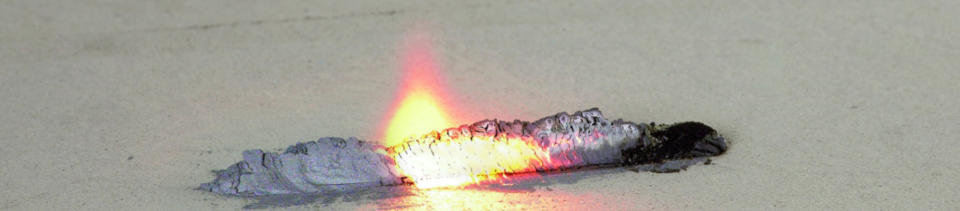
The determination of the burning behaviour enables assessment of whether a material layer, when in contact with an external ignition source shows a reaction such as ignition or smouldering. It also measures the ability of the locally induced reaction to propagate through the material in bulk or layer form. The behaviour in the test is characterized as a combustion class (see table below). The burning class allows qualitative estimations on the burning behaviour of a dust layer as well as on the probability of transfer of glowing particles and glowing nests from upstream connected parts of a plant. It is therefore in certain cases a basis for explosion prevention and protection measures. In addition to that the burning class is used as basis to decide whether fire prevention and protection measures are necessary The material under test is first sieved to remove particle sizes greater that 250 micron, then poured onto a fire-resistant plate to form an unbroken strip of test material approximately 40 mm long by 20 mm wide and contained within a glass tube. A light airfow through the tube is maintained during the test in the direction of combustion propagation to remove any gases that may inhibit combustion. An electrically heated glowing platinum wire is applied at one end of the product strip for 5 seconds and the course of combustion is observed and recorded. The test can be performed at room temperature or at elevated temperature – usually 100 o C – or at specific temperatures to match process conditions (e.g. drying ovens).
Outcome of combustion class


Type of reaction
Outcome
Class
Type of reaction
No spreading of fire
No ignition
1
Brief ignition and rapid extinction
2
Localised combustion or glowing
with practically no spreading
3
Fire spread
Glowing without sparks or slow
decomposition without flame
4
Burning with flame or spark
generation
5
Very rapid combustion with flame
propagation or rapid
decomposition without flame
6











Explosion Testing


© March 2024